
7th Joint Call: RESCuE-2
Background
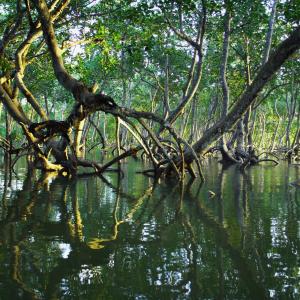
Southeast Asia’s coastal zones are home to millions of people, many living below the poverty line and heavily reliant on mangroves for fisheries, aquaculture, and timber. Mangroves are highly productive ecosystems that protect coasts from tsunamis and hurricanes, mitigate climate change, and support livelihoods. Yet, annual losses from deforestation, overexploitation, and climate change (sea level rise, altered rainfall) remain immense.
Despite international attention such as the UN Decade on Ecosystem Restoration (2021–2030) current restoration often relies on ineffective monoculture plantations that fail to restore full ecological functions. There is an urgent need for an evidence-based restoration framework that addresses coastal dynamics, biodiversity, socio-economic factors, and long-term sustainability.
The project
RESCuE-2 will:
- Monitor and optimise mangrove restoration design using remote sensing, field surveys, and modelling.
- Develop multi-scale spatio-temporal information to guide effective restoration and biodiversity conservation.
- Connect local restoration actions with national and regional policy frameworks.
- Test innovative restoration strategies that go beyond monoculture plantations.
- Strengthen collaborations among European and Southeast Asian scientists, policymakers, and communities.
- Build research capacity, especially for early-career scientists in ASEAN and Europe.
The science
The project combines ecology, forestry, geography, data science, and social sciences.
- Remote sensing and GIS to map mangrove cover and monitor restoration outcomes.
- Agent-based and stochastic modelling of mangrove forest dynamics (e.g. BETTINA and MANGA models).
- Socio-ecological analysis of community-based restoration strategies.
- Comparative evaluation of restoration methods to determine ecological effectiveness and cost-efficiency.
- Policy-relevant outputs for adaptation and resilience under climate change.
The team
The RESCuE-2 partners are:
- Prof. Dr. Uta Berger (Coordinator), Technical University Dresden (TUD), Germany
- Dr. Ronny Peters, Dr. Martin Zwanzig, Dr. Robert Schlicht, TUD, Germany
- Prof. Farid Dahdouh-Guebas, Université Libre de Bruxelles, Belgium
- Prof. Claude Garcia, Berner Fachhochschule, Switzerland
- Dr. Hélène Dessard, Dr. Valéry Gond, CIRAD, France
- Dr. Johann Oszwald, Prof. Samuel Corgne, Université Rennes 2, France
- Stefano Cannicci, University of Florence, Italy
- Independent researchers: Dario Simonetti, Italy, Andreas Langner, Germany
- Kim Soben, Royal University of Agriculture, Cambodia
- Meas Rithy, Ministry of Environment, Cambodia
- Assoc. Prof. Satyanarayana Behara, Ph.D. Jarina Mohd Jani, Universiti Malaysia Terengganu, Malaysia
- Prof. Patiya Kemacheevakul, Uday Pimple, King Mongkut's University of Technology Thonburi, Thailand
- Kumrom Leadprathom, Royal Forest Department, Thailand
- Sukan Punkul, Department of National Park, Wildlife and Plant Conservation, Thailand
- Poonsri Wanthongchai, Tamanai Pravinvongvuthi, Suchart Yamprasai, Department of Marine and Coastal Resources, Thailand
- Tetsu Ito, XASN Co. Ltd, Japan
Contact:
Prof. Dr. Uta Berger E-Mail: uta.berger@tu-dresden.de